
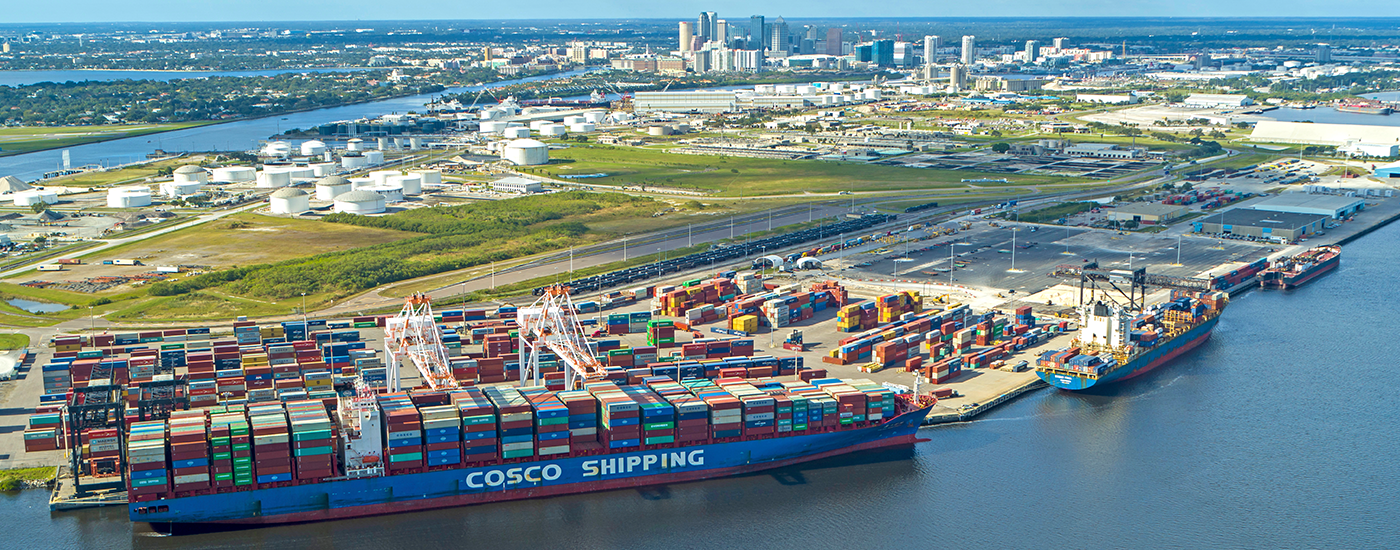
Port Tampa Bay is Florida’s largest and most diversified seaport and the largest economic engine in West Central Florida. Located on the Interstate-4 Corridor, Port Tampa Bay supports varied maritime and related activities, including shipbuilding and repair facilities, cruise, and is the largest cargo port by tonnage and land mass in the state. Building on a rich history as a leading bulk port, Tampa today accommodates a broad mix of bulk, break-bulk, roll-on/roll-off, and container cargo.
Port Tampa Bay’s growing container volume—an average of 28% annually over the last 5 years—is the result of an aggressive infrastructure and terminal build-out program, working closely with terminal operator partner Ports America. The port recently completed an expansion of paved storage, bringing the total container terminal footprint to nearly 100 acres. Work has commenced on the addition of a third berth, which will bring the total to over 4,500 linear feet, allowing three large container ships to be worked at the same time. A new container gate complex and three additional STS post-Panamax gantry cranes for a total of five, as well as three heavy-lift mobile cranes, will bring the annual terminal capacity to 1 million TEUs—more than enough capacity to satisfy the future container shipping needs of the rapidly growing Central Florida market.
Since Port Tampa Bay is the closest port to Florida’s hub for the grocery and food and beverage sector, another key facility is the new Port Logistics Refrigerated Services 135,000 SF cold storage facility. Port Tampa Bay is also the energy products gateway to West and Central Florida, importing the oil and gas needs for a huge regional market, as well as the jet fuel needs for the international airports in Tampa and Orlando. The port’s main petroleum products terminal complex recently underwent massive expansion and modernization.
Goals & Objectives
- Expand and diversify the business base by executing a supply chain sales strategy.
- Fulfill West/Central Florida’s long-term energy requirements.
- Optimize Tampa Bay’s vessel access.
Current or Planned Investments
- EAST PORT IMPROVEMENTS
200-ft berth 150 extension and 10-acre upland yard expansion. - NEW CONTAINER BERTH 214 AND CRANES
- OTHER AGGREGATES PROJECTS
(Berth 218, Berth 301, and Port Redwing Access Road).
Accomplishments
- Secured new direct container services from Asia, Central America and Mexico
- Completed the expansion and deepening of the Big Bend channel, which connects to the main channel in Tampa’s harbor and will allow larger vessels to dock along the channel and facilitate the movement of goods through the Port to the Interstate 4 corridor
- As a result of the Port’s ongoing strategy to continue to diversify its lines of business, the Port has seen continued cargo growth across most commodities and strong financial performance, despite the challenges of the pandemic
Hinterland
Bulk/Break-bulk: Central Florida for energy, building, citrus and fertilizer products.
Container: Florida, and through CSX, the U.S. Midwest and entire eastern seaboard.
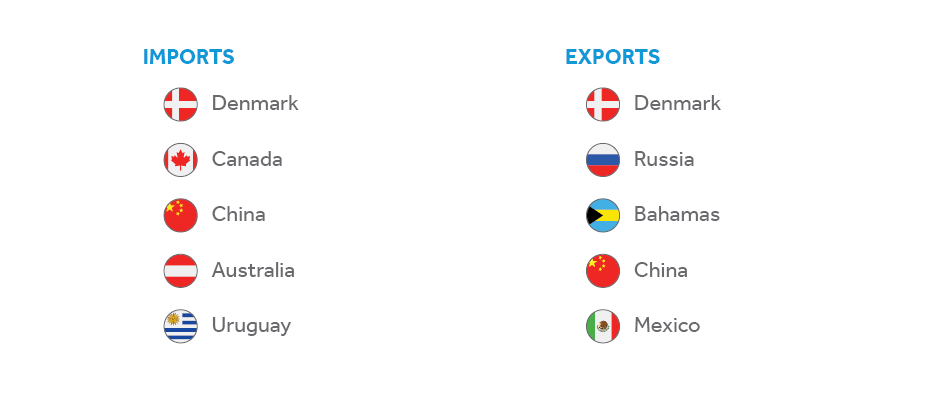
Trade Partners
Mission
The [Tampa Port Authority] TPA will be recognized as a leader in the maritime industry. The TPA will have a customer-driven, strategic business focus in working with stakeholders to develop and manage marine terminals and supporting infrastructure for the benefit of the regional economy. The TPA will employ sound financial, business, and environmental management practices in fulfilling its mission.