
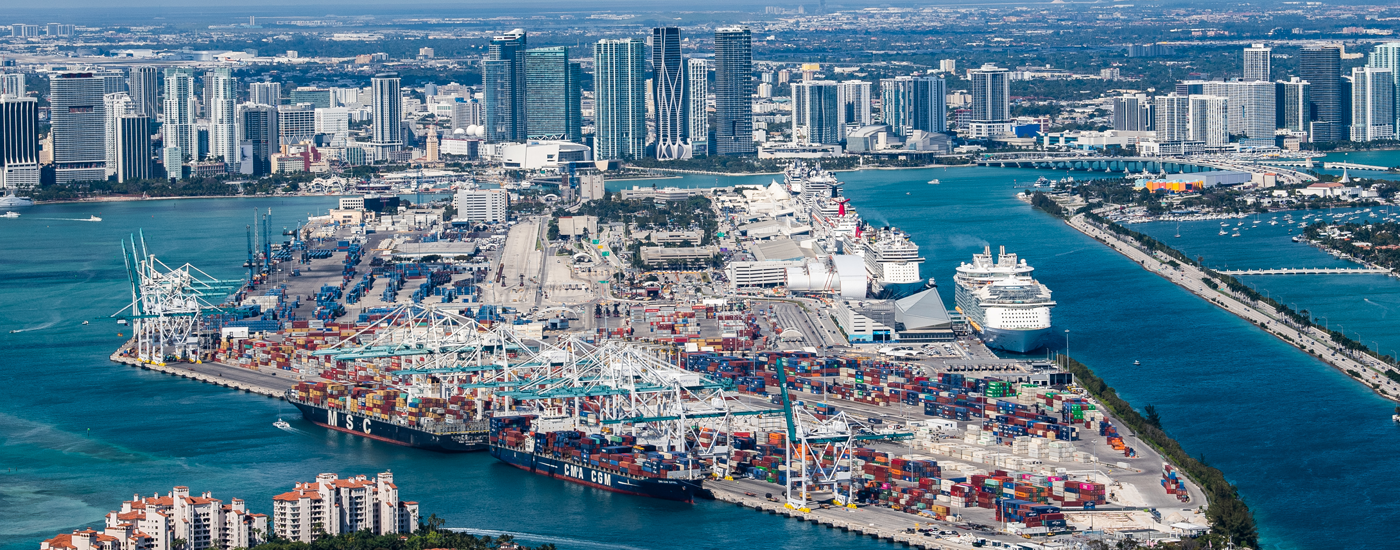
PortMiami stands as one of the two largest economic powerhouses in Miami-Dade County. With an annual economic impact of $61.4 billion, PortMiami supports 340,078 jobs, highlighting its significant regional and global influence.
The Port’s sustained performance propels Miami to be recognized as the Cruise Capital of the World© and the Cargo Gateway of the Americas. With a focus on excellence, innovation, and resiliency, the Port is setting the course to drive positive, sustainable change for cruise passengers, stakeholders, and the Miami-Dade County community it proudly serves.
The seaport operates as a landlord Port and partners with over 20 cruise line companies, including top brands such as Carnival Corporation & plc, Royal Caribbean Group, MSC Cruises, Norwegian Cruise Line Holdings, and Virgin Voyages. It collaborates with three cargo terminal operators: Port of Miami Terminal Operating Company, Seaboard Marine, and South Florida Container Terminal. Additionally, 13 shipping lines handle cargo at the Port, with all top five international shipping companies— CMA CGM, COSCO, Hapag-Lloyd, Maersk, and MSC —calling at the Port. PortMiami has significant trade relationships with three geographic regions: Latin America & Caribbean (48%), Asia (31%), and Europe (20%).
A commitment to its long-term vision and, coupled with strategic and effective partnerships, has significantly contributed to PortMiami’s growth and development. In recent years, the Port has inaugurated three new cruise terminals, with another currently under construction and set to open in early 2025. This latest terminal will be the world’s largest cruise terminal, capable of handling three cruise ships simultaneously. Additionally, the Miami-Dade Board of County Commissioners has approved Royal Caribbean Group’s new Cruise Terminal G, expected to open in late 2027. These projects help maintain PortMiami as the largest cruise port in the world.
In fiscal year 2024, cruise operations set new records. PortMiami experienced a 13% increase in cruise passenger volume, reaching 8,233,056, up from its previous record of 7,299,294 last year. In terms of cargo operations, PortMiami is Florida’s top international cargo port and one of Florida’s busiest perishables gateways. In fiscal year 2024, the Port handled 1,089,443 TEUs, placing PortMiami 11th in the United States based on container volume and first in the State of Florida for international containerized cargo.
PortMiami’s mission is to provide sustainable port services by carefully balancing environmental, capital, and economic factors in its business planning to ensure a resilient workplace today and in the future. PortMiami is committed to proactive policies that enhance its sustainable balance with customers, operations, and development while protecting its surrounding natural resources.
Goals & Objectives
- Continued development of the world’s leading cruise port, improving cruise infrastructure, and increasing cruise passenger activity while providing an exceptional experience.
- Maximize assets and strengthen the Port’s advantage for future growth and sustainability and operate in an environmentally responsible manner.
- Further develop the largest net-zero container port in the State of Florida, targeting new markets, increasing cargo traffic, promoting international trade and commerce, and positioning the Port as a vital link and growing epicenter for global trade.
Current or Planned Investments
- ROYAL CARIBBEAN GROUP’S CRUISE TERMINAL G
Development of a new cruise terminal and multi-level shared parking garage with ground-level intermodal facility, connecting roadways, and a provisioning building necessary to accommodate up to 7,000 cruise passengers. The project is expected to be completed by the end of 2027. - NORTH BULKHEAD IMPROVEMENTS
The North Bulkhead Project is PortMiami’s 7,200 linear feet of cruise berths that are reaching the end of their useful life. If these berths are not replaced, cruise activity could relocate outside of Florida due to the lack of remaining cruise berth capacity in the state. The “Project” is critical to maintain the 45,309 jobs and $10.1 billion to the state economy, generated from our world leading 7.2 million annual cruise passenger movements. The initial estimated project cost was $350 million in 2022, however the current cost estimate is approaching $1 billion. - SOUTH FLORIDA CONTAINER TERMINAL CARGO YARD IMPROVEMENTS, PHASE 2
This project involves a series of upgrades to the existing cargo yard, enabling the use of electrified rubber tire gantries. Improvements include constructing new concrete runways, installing refrigerated container racks and related electrical work, and performing drainage and pavement repairs. The project is scheduled for completion in late 2026. Additional benefits include more efficient container stacking and a potential 40% increase in TEU capacity.
Accomplishments
- Consistent cargo growth reflecting over 1 million TEUs for over 5 years in a row
- Cruise growth increase to a record 6.79 million passengers in FY2019 along with new contracts for continued growth
- Continuous safe and secure operations in a sustainable environment
Hinterland
For east-west trade the hinterland extends from the south Florida counties of Miami-Dade, Broward, Monroe and Palm Beach throughout the state. For north-south trade it includes all of Florida and extends into the Southeast, Northeast and Midwest of the United States.
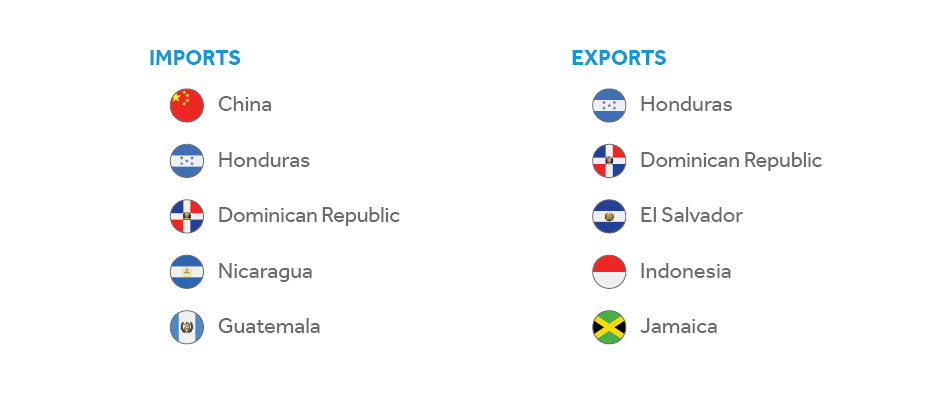
Trade Partners
Mission
PortMiami’s mission is to operate and further develop the world’s leading cruise port and the largest container port in the State of Florida; to maximize its assets and strengthen its advantage for future growth; promote international trade and commerce as a vital link between North and South America and a growing center for global trade; support sustainability and operate in an environmentally responsible manner.